Anna Spangler
Marketing Director & Co-Owner
Key Takeaways:
- Conservative management is a structured non-surgical protocol, not just crate rest.
- Programs typically include activity restriction, rehab exercises, weight management, and joint support.
- Healing takes months and progress should be monitored.
- Guidance from your team of veterinary and rehabilitation professionals improves outcomes and reduces compensatory injuries.
You’re at the vet’s office to find out why your dog is limping. Your vet has reviewed your dog’s recent history, manually felt and manipulated the injured leg, conducted a “drawer test”, taken X-rays, and maybe even referred you to a specialist. You finally hear the diagnosis. Your dog has a CCL injury.
A Cranial Cruciate Ligament (CCL) injury is a tear of the ligament that connects the femur bone to the tibia. The same ligament in humans is called an ACL. When this ligament is torn, the tibia no longer stays in alignment, and thrusts forward. This shifting is painful and exhibits as limping or your dog not bearing weight on their injured leg.
What Is Conservative Management for a CCL Tear?
Next step is deciding on the best treatment plan for your dog and your family. Your veterinarian will discuss surgical options as well as conservative management.
There are several different surgeries that address the CCL tear. The most common surgery is a TPLO (Tibial-Plateau-Leveling Osteotomy) where they cut, rotate, and attach a plate from the tibial to the femur. Recovery is typically 12 weeks, with firm restrictions.
Conservative management focuses on stabilizing the knee and supporting healing without surgery. Dogs naturally heal from CCL injuries with the formation of scar tissue. You can help aid the natural healing process through various conservative management techniques.
What Conservative Management Includes
Conservative management may be overseen by your local veterinarian or your rehabilition therapist. It’s important to discuss the services each provide and decide the best fit for you and your dog. If you are primarily working with a rehab therapist for your treatment, be sure that your veterinarian is up to date with the plan.
Your conservative management treatment plan may include:
Activity Restriction
- Crate rest for several weeks
- Leashed walks
- Preventing stairs, jumping, playtime
Weight Management
- Losing weight as excess pounds put more stress on the joints
Rehabilitation & Therapeutic Exercise
- Controlled leash walking, such as figure right exercises
- Underwater treadmill
- Laser therapy
Joint Support
- Medication to reduce inflammation
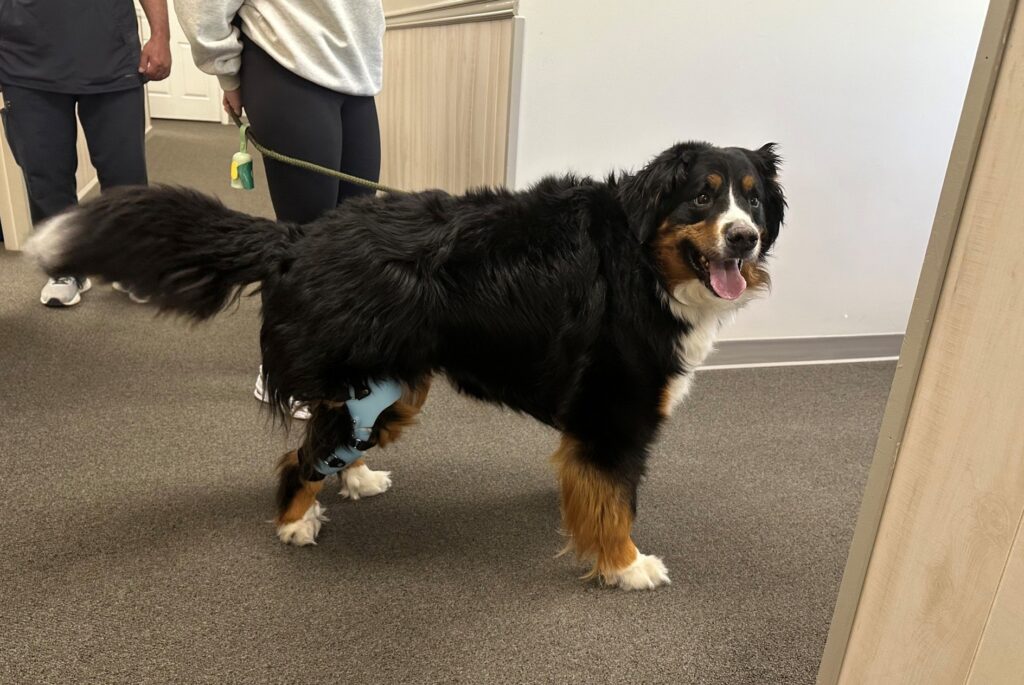
- Custom knee brace
Reasons to choose conservative management
- Your goal is to give your dog the most normal quality of life, go for walks, no crate rest
- Your dog has other medical conditions that don’t make them a good candidate for surgery
- Your dog doesn’t qualify for surgery due to their excess weight
- High financial cost of the surgery
- Advanced age or anesthesia risk of your dog
- You may have difficulty following through with post-up care/crate rest
- Surgery increases the risk of their other hind leg sustaining a CCL injury
Healing Timeline & What to Expect
CCL tears are serious injuries that require attentiveness and patience. Families should expect to see a slow, gradual improvement in their dog’s condition. Most dogs will take 6-9 months to heal from a cruciate injury.
Some dogs may have setbacks during the healing process. You were seeing improvement, then they jump off the couch or run to greet someone at the door, and they’re limping more than they were before. If this happens, reduce their activity level and contact your veterinarian or rehab therapist.
Signs Conservative Management Is Working vs. Not Working
You’ll know your treatment plan is working when your dog begins to put more weight on the injured leg and limp less. It should also become easier for them to stand up from a lying position. As you gradually increase their activity, their weight-bearing should remain steady without setbacks. Walks will get longer and that tail will be wagging!
If you don’t see improvement in weight-bearing after several weeks, or if there’s a sudden decline in progress, consult your veterinarian or rehabilitation team. Your dog may have aggravated the injury, or there could be another issue affecting recovery. Other common knee conditions, such as luxating patellas or meniscal injuries, can also contribute to ongoing limping.
Q&A:
Q: Is conservative management always appropriate for CCL tears?
A: Not always. Conservative management is effective for full or partial tears. Conservative management typically has a longer healing time compared to surgery. Full ruptures will also take longer to heal than partial ruptures with conservative management.
Q: Can my dog still go up and down stairs?
A: Stairs are really hard on your dog’s knees, especially going up. For the first two to three months after your dog is diagnosed with a CCL injury, do your best to prevent full flights of stairs. If they have to use stairs, use a towel or sling to help them up (or carry them if they’re small enough).
Q: Is surgery always better for CCL tears?
A: What’s better depends on you and your dog. Is surgery a financial option for your family? What type of quality of life do you want your dog to have for the next few months to the next year? Are you able to manage post-surgical restrictions? Do you lean towards holistic solutions or maybe a quicker surgical treatment plan? Better is all dependent on your goals.
Q: Can large breeds recover without surgery?
A: Yes, large breeds can recover from a CCL tear without surgery. Your veterinarian or rehabilitation therapist will tailor a plan to their injury and anatomy.
Q: How long until my dog can play again with conservative management?
A: Besides some limping, your dog still acts like they want to run and play with their CCL injury. In the interest of their long-term recovery, it is important that you restrict their activity level for the first two to three months. You can still most likely go for walks, but more strenuous activity should be avoided to help scar tissue form good and strong. It will be approximately six+ months before your dog can fully play again.
A conservative management treatment plan for CCL tear is a structured multi-component strategy created by your veterinarian or rehabilitation therapist to get your dog back to their normal activity level. It may include water therapy, a custom knee brace, exercises at home, or other modalities. Conservative management is a longer healing process than surgery, but less invasive and enables your dog to live a moderately normal life while they heal. Seeing your dog injured and limping is heart wrenching. It’s not easy navigating the medical jargon, but there are options for you to choose what’s best for your four-legged family member.